
Reviewed · CITY TOURS
Buenos Aires: Hop-On Hop-Off City Bus Tour
Buenos Aires is a huge city, and this bus gives you a useful first look at its many personalities in one long circuit. You can pass from Congress and San Telmo to La Boca, Puerto Madero, Palermo, Belgrano, and Recoleta without figuring out each connection on your own. The full loop takes about three hours, so plan your stops rather than expecting a quick ride.
I like the wide city coverage, especially the chance to reach La Bombonera, Caminito, the Planetarium, Chinatown, and River Plate’s Monumental stadium on one route. I also like the clear multilingual commentary, which adds local music between sections and helps you understand what you are seeing.
The main drawback is timing. Buses are scheduled about every 25 minutes, but traffic and boarding can stretch the wait to 35 minutes. Commentary can also arrive just after a building or sight has passed, and the upper deck may feel cool on some days.
In This Review
- Key points to know before you board
- Why this bus works well in Buenos Aires
- From Congress to San Telmo and La Boca
- Puerto Madero, the riverfront, and central Buenos Aires
- Palermo, Recoleta, and the city’s greener side
- Chinatown, polo, and the return toward the center
- Audio commentary, WiFi, and onboard comfort
- Choosing 24, 48, or 72 hours
- Who should book this Buenos Aires bus tour?
- Should you book it?
- FAQ
- Where can I start the Buenos Aires hop-on hop-off bus tour?
- How long does one complete bus loop take?
- How often do the buses run?
- What are the operating hours?
- Which languages are available for the audio guide?
- Are museum and stadium admissions included?
- How long does the ticket remain valid after purchase?
Key points to know before you board
- One long loop covers the city’s main districts: Expect roughly three hours for a complete circuit without getting off.
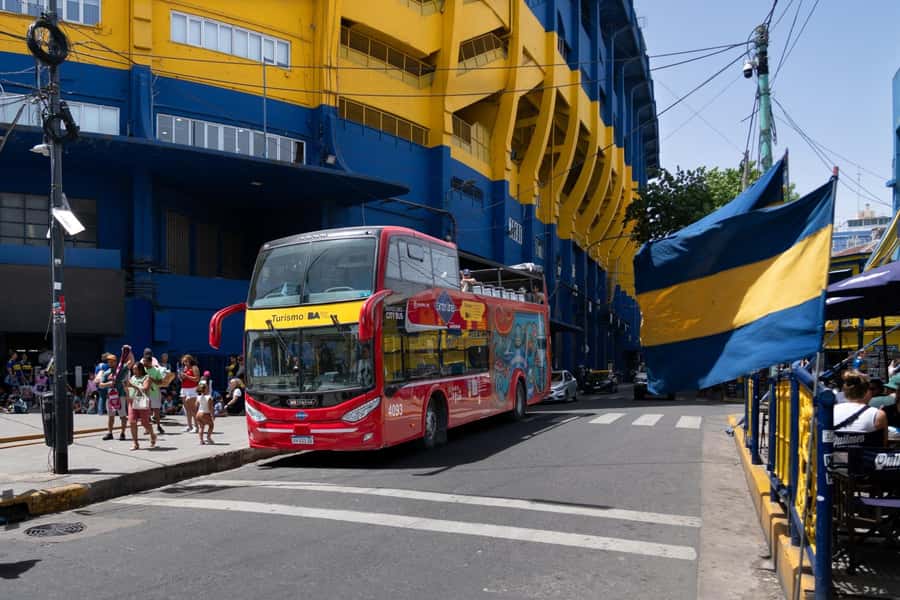
- La Boca is the essential stop: Use the bus for Caminito and La Bombonera, then allow time to walk around.
- A 48-hour ticket offers the best working pace: It gives you room to stop, eat, and reboard without rushing.
- The bus is both tour and transport: You can listen from the top deck or use it to reach a chosen attraction.
- Commentary comes in 11 languages: Audio is available in Spanish, English, Portuguese, Japanese, Chinese, Russian, Italian, French, German, Ukrainian, and Korean.
- The service runs from 9:30 a.m. to 6 p.m.: The last departures at 5:30 p.m. only complete half the route.
Why this bus works well in Buenos Aires
Buenos Aires is not a city you can neatly cover on foot in one morning. Its districts spread across a broad area, and the character changes quickly from grand civic buildings to old neighborhood streets, dockside towers, leafy parks, football grounds, and modern cultural centers.
This route helps you get your bearings fast. Start at Stop 0 on Diagonal Norte, at Avenida Presidente Roque Sáenz Peña 728, or at the operator’s office at Plaza San Martín, Avenida Santa Fe 808. You can also board at any listed stop, so the bus may be useful even if you are staying away from the center.
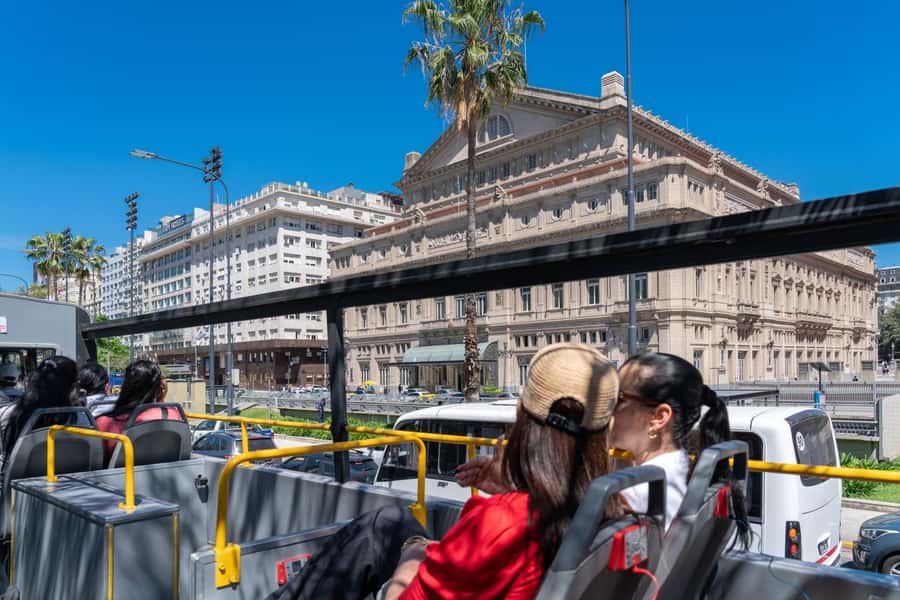
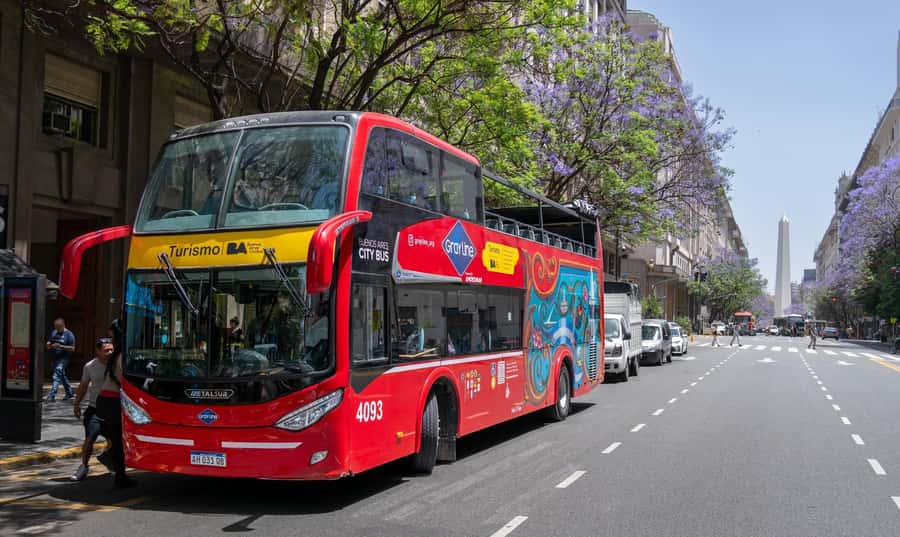
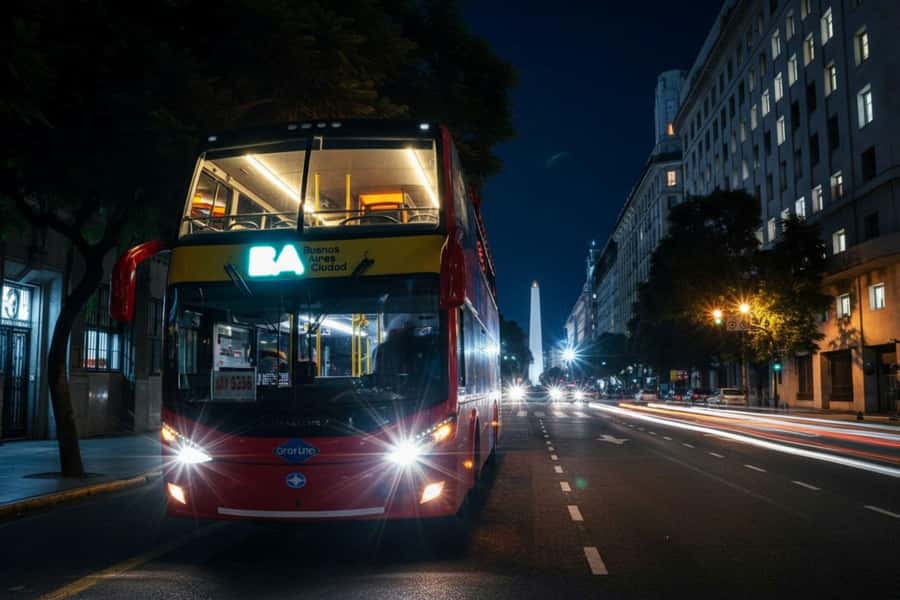
The open-top double-decker design gives you a better view than a regular city bus. On a warm, clear day, the upper deck is the best place to watch the city pass by. Air conditioning and a sunroof help when the weather turns hot, though the upper level can feel chilly at times. Earphones are supplied for the audio guide, but the cables may be short for some upstairs seats.
I would treat the first circuit as an orientation ride, not as wasted time. Stay aboard for the whole loop if you have only a few hours. You will see where the main districts sit, learn which stops deserve a longer visit, and avoid spending your first day working out the city’s shape.
A few more Buenos Aires trips to weigh up
- Buenos Aires: City Highlights Guided Tour with Transfer
★ 4.7 · 1,946 reviews - Best of Buenos Aires: Guided Sightseeing City Tour
★ 4.0 · 402 reviews - Buenos Aires Private City Tour with Local Guide
★ 5.0 · 308 reviews
From Congress to San Telmo and La Boca
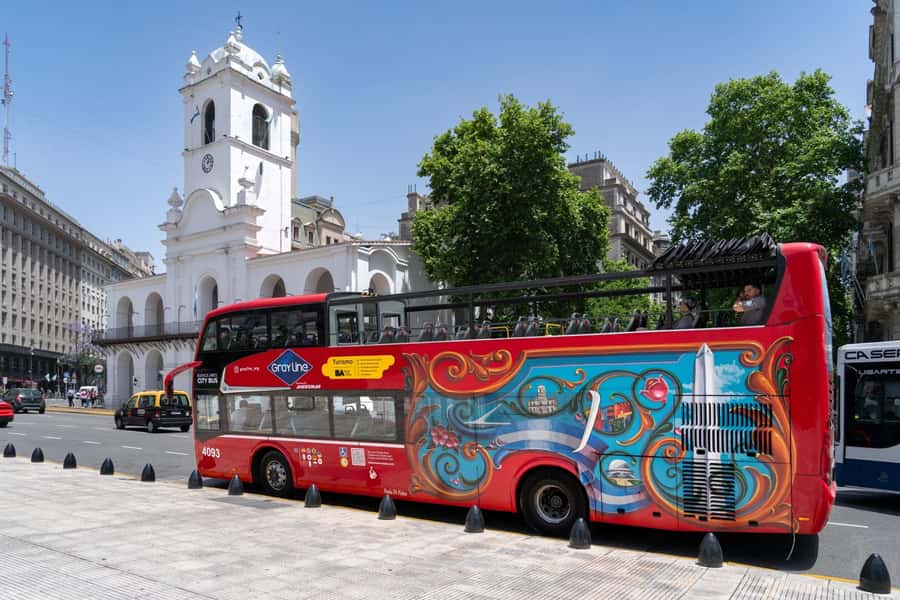
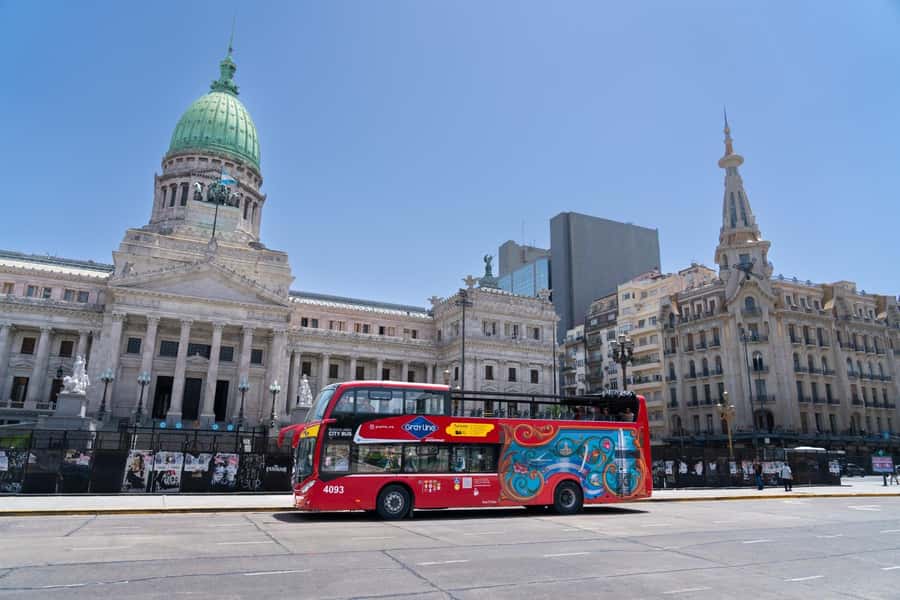
The central section begins near the Argentine National Congress. The building is one of the city’s grand civic landmarks, and passing it gives the route an immediate sense of Buenos Aires as a capital built on a large scale.
The bus then heads toward the Paseo de la Historieta, marked by El Loco Chávez, before reaching the San Telmo area and Plaza Dorrego. San Telmo is one of the best places to leave the bus if you want older streets, small squares, and a more traditional neighborhood feel. Plaza Dorrego is the natural focal point, but the stop is listed as a pass-by point in the route information, so check the current bus signage and stop map before assuming you can board directly beside every attraction.
Next comes Usina del Arte, a former power station turned cultural space in the southern part of the city. It is a useful reminder that Buenos Aires is not only about colonial-looking streets and grand avenues. The route then reaches La Bombonera, the famous home stadium of Boca Juniors.
For football fans, this is one of the bus’s most valuable stops. A separate Boca Museum visit can be accessed from the Bombonera stop, though museum admission is not part of the bus ticket. On days when Boca is playing at the stadium, no tours take place, so check the schedule before building your day around this section.
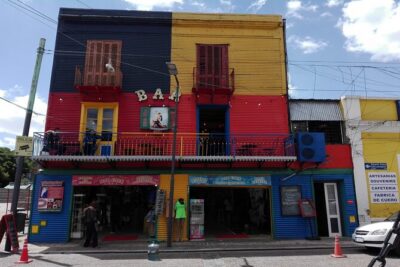
Caminito is the stop I would prioritize in La Boca. Its brightly painted buildings and street art make it one of Buenos Aires’s most recognizable areas. The bus gets you close, but the real point is to get off and walk. Give yourself enough time to look around instead of taking a quick photograph and rushing back for the next bus.
Puerto Madero, the riverfront, and central Buenos Aires
After La Boca, the route passes Costanera Sur and Puerto Madero. Costanera Sur brings you toward the city’s open riverfront edge, while Puerto Madero offers a sharp change in mood, with modern buildings and restored dockside spaces.
This section is useful because it shows how Buenos Aires keeps contrasting old and new districts within a short distance. You might find the commentary especially helpful here, since the audio explains the places passing by while you remain seated above traffic.
The route also includes the tourist circuit’s river station. From there, you are positioned for river-related activities and nearby attractions, although those activities are not included in the bus fare. Do not assume every stop equals an included admission ticket. The bus gets you there, but museums, food, drinks, and other activities cost extra.
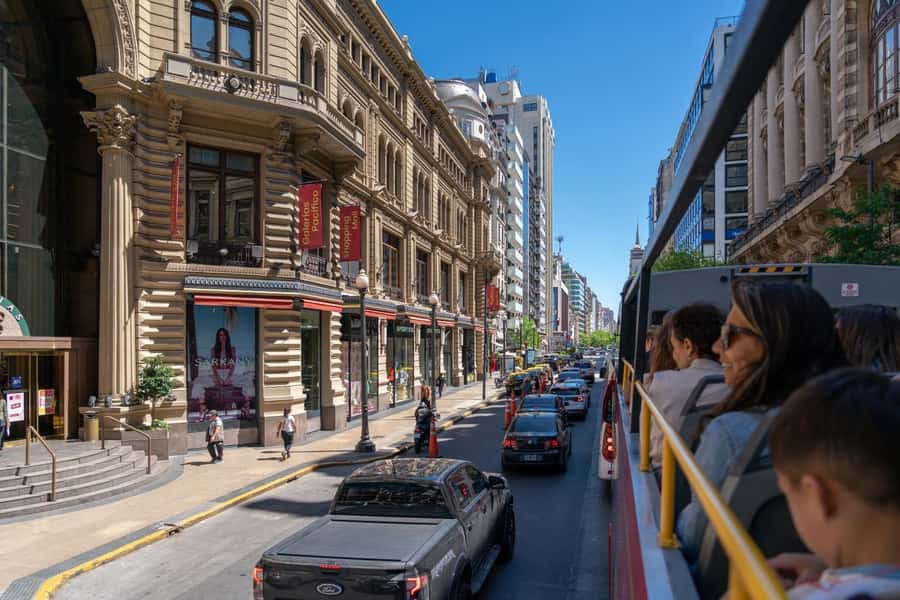
Galerías Pacífico brings the bus back toward the central shopping and architectural core. The nearby Plaza General San Martín stop at Avenida Santa Fe 808 is one of the two main starting points and the operator’s office. It is also a practical place to begin if you want to ride north first.
The center can be slow because of traffic. Keep the 25-minute frequency in mind, but do not plan a museum reservation around a precise reboarding time. A bus can be delayed while passengers get on and off, and the route itself may take longer than expected.
Palermo, Recoleta, and the city’s greener side
The northern stretch includes the Floralis Genérica, the Museum of Latin American Art of Buenos Aires, and the Planetario Galileo Galilei. These stops make the bus useful for visitors interested in art, design, parks, and science.
Floralis Genérica is one of the city’s most recognizable modern monuments. The Latin American Art Museum is a major cultural stop, but admission is not included. If you plan to visit, use the bus as transport and allow enough time for the museum itself rather than trying to squeeze it between two buses.
The Planetarium is another good stop for families and anyone interested in science. The route passes through Palermo, one of the city’s more modern and spacious districts, where the atmosphere differs from San Telmo and La Boca. You will get a broad view from the bus, but the route cannot replace walking if you want to explore cafés, side streets, or parks in detail.
The Club de Pescadores and Jorge Newbery Airfield follow. These are more about seeing the city’s river edge and transport infrastructure than checking off famous monuments. They help make the route a true city circuit rather than a short downtown sightseeing ride.
Parque de la Memoria is a meaningful stop connected with remembrance and public history. If you get off here, allow time for a thoughtful visit. It is not the kind of attraction to treat as a five-minute photo stop.
The route continues to Estadio Monumental Antonio Vespucio Liberti, home of River Plate. The River Museum can be reached from this stop, but its admission is separate. As with La Bombonera, stadium match days affect the service, and no tours take place when River or Boca are playing at their grounds.
Same city, a completely different kind of day:
- Buenos Aires Hop-On Hop-Off Bus, Free Walking Tours & Discounts
★ 4.5 · 2,218 reviews - Buenos Aires: Piazzolla Tango Show with Optional Dinner
★ 4.4 · 2,122 reviews - Buenos Aires Hop-On Hop-Off Bus and Exclusive Benefits
★ 4.4 · 1,714 reviews - Buenos Aires: La Boca Guided Walking Tour in English
★ 4.8 · 1,587 reviews
Chinatown, polo, and the return toward the center
The Chinatown stop gives you another change of scene. It is a useful choice for lunch or a short walk, especially if you want a neighborhood experience beyond the standard historic center.
The Argentine Polo Association and Carta Magna Monument follow. These stops suit a broad city tour because they show parts of Buenos Aires that you might not reach on a short walking itinerary. The bus is particularly useful here if you are trying to connect several northern districts in one day.
Recoleta comes later on the route and deserves serious time. It is one of the city’s best-known districts, with major cultural and historic sights nearby. The supplied route information notes that a yellow bus has a stop at the famous Buenos Aires Cemetery, while the red bus route does not stop directly there. The nearest red-route stop is about a mile away, so do not assume the Recoleta stop puts you at the cemetery entrance.
That detail matters. If the cemetery is high on your list, check the route color and current stop map before you board. You may prefer to use the bus for the surrounding district and make the final approach by another form of transport.
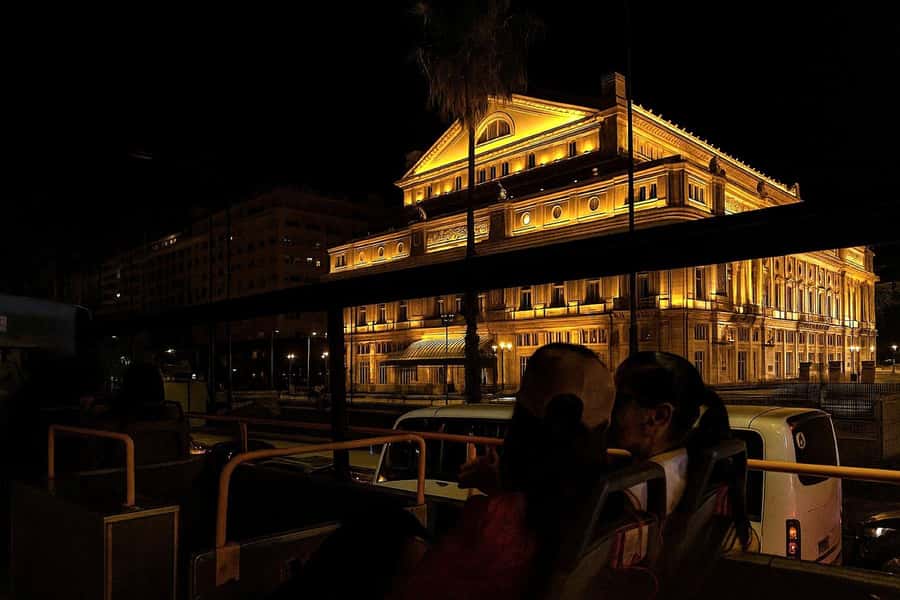
The final listed stop is Teatro Colón, Buenos Aires’s celebrated opera house. Even from the bus, the theater helps complete the picture of the city’s grand central core. After that, the loop returns toward the starting points.
Audio commentary, WiFi, and onboard comfort
The audio guide is one of the strongest parts of this experience. You can listen in 11 languages, including English, Spanish, Portuguese, Japanese, Chinese, Russian, Italian, French, German, Ukrainian, and Korean. Live staff are listed for Spanish, English, and Portuguese.
The commentary covers the buildings, neighborhoods, and history along the route. Its timing is generally useful, but it is not perfectly synchronized every time. You may hear an explanation as the bus reaches a sight or just after it passes. If a particular monument matters to you, use the commentary as background rather than your only source of information.
Local music plays between some sections, which makes a long ride feel less mechanical. The full circuit can run for more than three hours, and that length is both a benefit and a warning. You see much more of Buenos Aires than on a short central loop, but you need patience.
WiFi is offered on the bus and at bus stops. Treat it as a useful extra, not a reason to book. The connection may not work reliably, and you should not depend on it for essential navigation. A real-time map is available, but it can be hard to find and may need improvement.
The buses have air conditioning and a sunroof. Upstairs gives you the best views, while downstairs is the safer choice if the sun is strong or the air feels cold. Bring your own patience for traffic, and keep belongings close. If you leave something behind, contact the operator quickly. Lost property can be located, but you should not count on a quick recovery.
Choosing 24, 48, or 72 hours
At about $35 per person, the ticket is not the cheapest way to move around Buenos Aires. Its value comes from combining sightseeing commentary with transport across a large city.
A 24-hour ticket makes sense if you want one long orientation ride and a few carefully chosen stops. It can work well for a short stay or a day affected by a late flight. If you only remain on the bus for the full loop, you are paying mainly for the guided overview.
I see the 48-hour option as the best fit for most people. You can ride the full circuit on the first day, then return to La Boca, Recoleta, Palermo, or the football stadiums on the second. You also have time for lunch and museum visits without treating every 25-minute bus interval as a deadline.
A 72-hour ticket suits a slower visit, but its value depends on how often you plan to use the route. The service operates from about 9:30 a.m. to 6 p.m., and the last buses leave at 5:30 p.m. for only half a return. It is not an all-night transport pass.
Your ticket becomes active when you first board, not simply when you purchase it. You have six months from purchase to begin using it, and the selected 24, 48, or 72 hours starts with that first boarding.
Who should book this Buenos Aires bus tour?
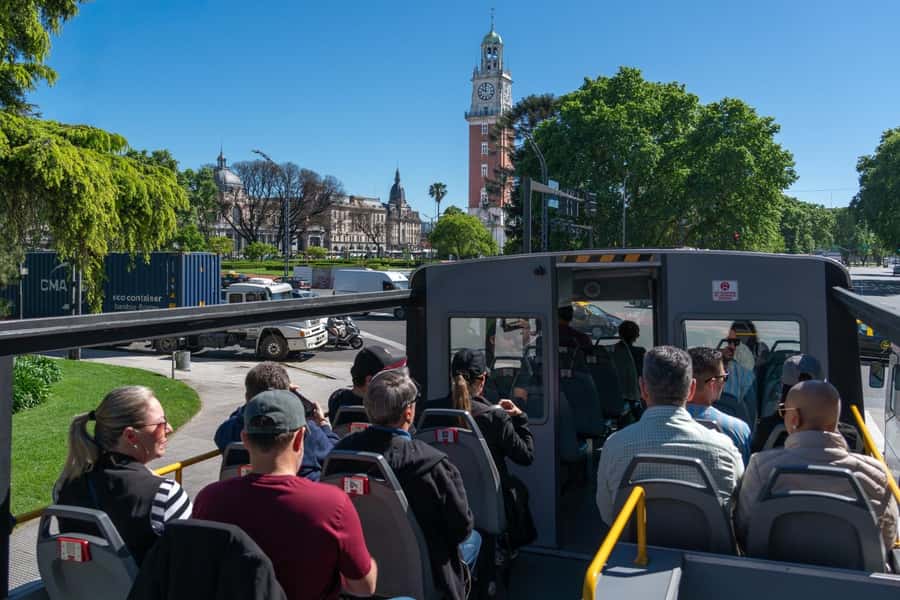
I would recommend it to first-time visitors, families, older travelers, and anyone who wants a broad view without mastering the city’s transport system on day one. It also suits you if you want to compare neighborhoods before deciding where to spend more time.
It is less useful if you already know Buenos Aires well, prefer small guided walks, or need exact point-to-point timing. Traffic can interfere with the schedule, and the long loop rewards flexibility rather than precision.
Free cancellation is available up to 24 hours before the activity, and you can reserve now and pay later. Hotel pickup and drop-off are not included, so you must reach a stop yourself.
Should you book it?
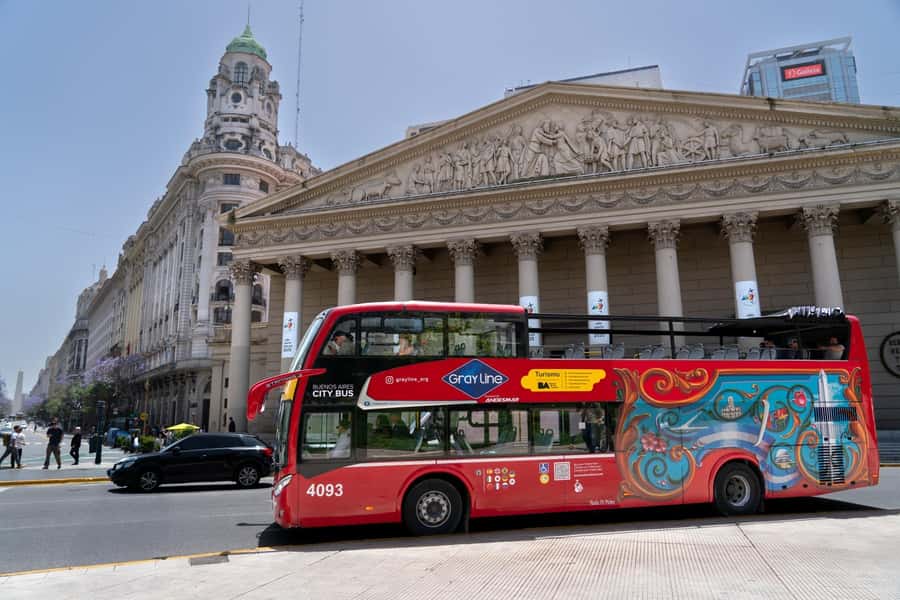
Book this tour if you want a practical first pass through Buenos Aires and plan to get off several times. The strongest plan is to ride the full loop early, note the districts that interest you, then use a 48-hour ticket to return to La Boca, Recoleta, Palermo, or one of the football stops.
Skip it if your time is so short that you can only make one fixed appointment, or if waiting in traffic will frustrate you. At $35, it earns its price when you use it as both a city introduction and a flexible way to cross Buenos Aires.
FAQ
Where can I start the Buenos Aires hop-on hop-off bus tour?
You can start at any bus stop. The two main starting points are Stop 0 on Diagonal Norte at Avenida Presidente Roque Sáenz Peña 728 and Stop 12 at Plaza San Martín, Avenida Santa Fe 808.
How long does one complete bus loop take?
A complete circuit takes about three hours without getting off. Traffic, boarding, and stop times can make the journey longer.
How often do the buses run?
Buses generally run every 25 minutes during the day. Actual waits can be longer because of traffic and passenger boarding.
What are the operating hours?
The bus operates Monday through Sunday from about 9:30 a.m. to 6 p.m. The final buses leave at 5:30 p.m. and complete only half of the route.
Which languages are available for the audio guide?
The audio guide is available in Spanish, English, Portuguese, Japanese, Chinese, Russian, Italian, French, German, Ukrainian, and Korean. Live staff are listed for Spanish, English, and Portuguese.
Are museum and stadium admissions included?
No. The bus ticket does not include admission to attractions, food, or drinks. The River Museum can be reached from the Monumental stop, and the Boca Museum from the Bombonera stop, but admission is separate.
How long does the ticket remain valid after purchase?
You have six months to begin using the ticket. Your selected 24, 48, or 72-hour period begins the first time you board the bus.
Just added around Buenos Aires
- Wine Tasting in Buenos Aires★ 4.2 · 4 reviews
- Tango Show at El Querandi with optional Dinner★ 4.2 · 3 reviews
- Walking Tour: Buenos Aires bookstores★ 4.3 · 12 reviews
- Velez Sarsfield Football Match★ 5.0 · 3 reviews
- Unique Tigre and Delta Private Day Cruise Navegation★ 5.0 · 3 reviews
- Tour Buenos Aires in one day on Electric Scooters★ 5.0 · 33 reviews
- Private Underground Tango Immersion★ 5.0 · 31 reviews
- Experience The Essence of Buenos Aires in San Telmo★ 5.0 · 51 reviews
City Tours, compared.

Best of Buenos Aires: Guided Sightseeing City Tour
Read our review →
Classic City Tour of Buenos Aires: Neighborhoods and Emblems
Read our review →

Tierra del Fuego National Park, Ushuaia City Tour Shore Excursion
Read our review →
Browse the lists this tour appears in