Reviewed · BUENOS AIRES TOURS
Electric Scooter Tour: North Buenos Aires
Buenos Aires reveals itself quickly from two wheels. This 10-kilometer ride links grand avenues, leafy Recoleta, political landmarks, and the city’s European-looking center while your guide explains football, barbecue, authority, migration, and the very Argentine art of self-expression. The stories are the point, not just the sightseeing.
I like two things here: the route covers a lot without asking you to march across the city, and the mate and alfajor break gives the tour a real local flavor. Guides Miguel and Rita are named in the tour material, and both are described as warm, lively storytellers who bring personal views to subjects such as politics, the economy, and Argentine attitudes.
The main caution is timing. The advertised length is about two and a half hours, but one family’s outing lasted four and a half hours, partly because weekend traffic and the route to Recoleta Cemetery slowed things down. If you have a tight schedule afterward, leave plenty of space.
In This Review
- Key things to know before you roll
- Why a scooter is a smart way to see northern Buenos Aires
- Starting near Tres Sargentos at 2 pm
- Plaza General San Martín and the city’s European character
- Torre Monumental, migration, football, and Little Ben
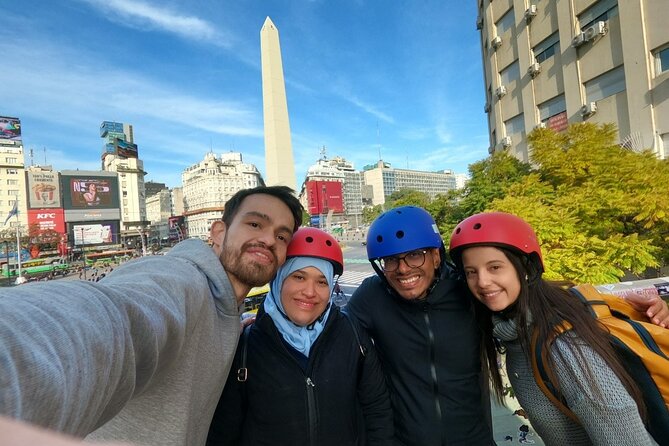
- The Obelisk, the great witness of Buenos Aires
- The French Embassy and Argentine self-confidence
- The Faculty of Law and Argentina’s public life
- Floralis Genérica and the best part of the cultural exchange
- Recoleta Cemetery and the people behind the nation
- Basilica del Pilar and the faith of Buenos Aires
- MALBA and the final museum note
- What $39 buys you
- Timing, cancellations, and practical limits
- Who should book the northern Buenos Aires ride
- Should you book it?
- FAQ
- Where does the tour start?
- What time does the tour begin?
- Where does the tour finish?
- How long does the experience last?
- How far do you ride?
- How many people can join?
- Is a helmet provided?
- Is food or drink included?
- Can I join if I cannot ride a bicycle?
- What happens if the weather is poor?
- How far in advance can I cancel for a full refund?
- Is admission to MALBA included?
Key things to know before you roll
- About 10 kilometers of Buenos Aires: You cover a large slice of the north side without exhausting yourself on foot.
- Mate beside Floralis Genérica: You learn how to prepare Argentina’s famous yerba mate and taste a chocolate alfajor filled with dulce de leche.
- A small group of up to eight: The size should make it easier to ask questions and hear the guide.
- A guide-led cultural route: Expect talk of football, migration, religion, politics, French influence, and Argentine habits.
- A mix of famous sights and practical advice: You pass major landmarks and receive suggestions for making better use of your time in Buenos Aires.
- Weather and cycling matter: The tour needs good weather, and you should be comfortable riding a bicycle.
Why a scooter is a smart way to see northern Buenos Aires
Buenos Aires is a city of grand distances. The Obelisk, Plaza General San Martín, Recoleta Cemetery, Floralis Genérica, and the Faculty of Law are not packed into one tiny historic quarter. You can reach them by public transport or on foot, but this ride gives you a simple middle ground.
You move far enough to see how the city changes from the central business area to the polished northern districts. The 10-kilometer route also keeps the day active without turning it into a full exercise session. Expect some wind in your face, and bring a light layer if the weather is cool.
The tour is designed around conversation. Your guide does not simply point at a monument and give you a date. The subjects range from why Buenos Aires feels so European to why Argentine speech can sound confident, theatrical, or even conceited to outsiders. Football and barbecue appear as windows into everyday life, not as side notes.
That approach is useful early in your stay. You leave with more than a list of landmarks. You get cultural clues that can help you understand a football reference, a mate ritual, or the tone of a conversation later in your trip.
A few more Buenos Aires trips to weigh up
- Tour Buenos Aires in one day on Electric Scooters
★ 5.0 · 33 reviews - Buenos Aires Night Tour on Electric Scooter
★ 5.0 · 33 reviews
Starting near Tres Sargentos at 2 pm
The meeting point is Tres Sargentos 463, in the C1054ABC area of Buenos Aires. The tour begins at 2 pm and returns to the same place, which makes the end easy to plan.
The group is capped at eight people. That is a good number for a moving tour. You are not trying to keep track of a large crowd at every crossing, and the guide should have a fair chance to respond to questions. Confirmation is provided at booking, and the starting point is near public transportation.
The supplied information uses both electric scooter and Segway language. The tour title describes an e-scooter ride, while the included equipment says use of Segway. I would confirm the exact vehicle with Rollin Argentina before booking, especially if the distinction matters to you.
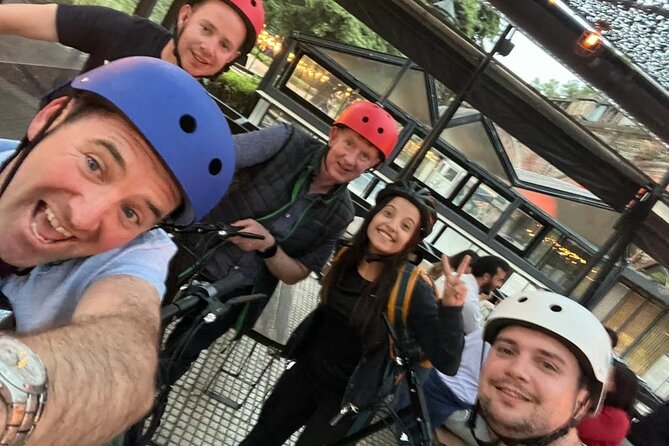
A helmet and reflective belt are included. You should already know how to ride a bicycle, since the activity is not recommended for people without that basic skill. Most people can participate, but the operator requires good weather.
Plaza General San Martín and the city’s European character
The first stop is Plaza General San Martín, with about 20 minutes set aside. This is where the guide introduces the question of Buenos Aires’s European feel.
That question is more useful than a standard architectural lecture. Buenos Aires can surprise first-time visitors with its grand civic spaces, formal avenues, and strong links to Europe. At the plaza, you begin to see how the city presents itself and why its identity is not simply Spanish or Italian, but a blend shaped by migration and local ambition.
Use this opening stop to ask questions. The tour’s wider discussion of migration, France, and Argentine self-image begins here. You are not merely looking at a square. You are getting a framework for reading the rest of the route.
Torre Monumental, migration, football, and Little Ben
The next stop is Torre Monumental, with around 15 minutes. The guide connects the tower with migration, football, and its resemblance to London’s Big Ben.
That combination tells you a lot about Buenos Aires. The city borrowed and adapted outside influences while building its own strong identity. The football discussion is especially welcome because football is not treated as a tourist decoration. It is part of the social language of Argentina, and the guide uses it to explain how people connect with place and community.
The stop is brief, so expect an explanation and viewing time rather than a long visit inside a building. The value comes from the context, especially if this is your first introduction to how migration shaped the capital.
Same city, a completely different kind of day:
- Buenos Aires Hop-On Hop-Off Bus, Free Walking Tours & Discounts
★ 4.5 · 2,218 reviews - Buenos Aires: Piazzolla Tango Show with Optional Dinner
★ 4.4 · 2,122 reviews - Buenos Aires: City Highlights Guided Tour with Transfer
★ 4.7 · 1,946 reviews - Buenos Aires: Hop-On Hop-Off City Bus Tour
★ 4.2 · 1,855 reviews
The Obelisk, the great witness of Buenos Aires
The Obelisk gets about 10 minutes. It is a short stop, but an important one.
The monument is a visual marker for Buenos Aires and a natural point for discussing the city’s public life. Your guide presents it as a witness to the capital’s major celebrations, arguments, and gatherings. The exact stories will depend on the guide, but the stop gives you a place to connect the city’s grand scale with its political and football passions.
Ten minutes will not allow for a long exploration. That is fine. The Obelisk works best as a quick orientation point before the ride continues north.
The French Embassy and Argentine self-confidence
At the French Embassy, the guide spends about 10 minutes asking why Argentinians have a reputation for being conceited.
This is one of the tour’s more interesting turns. It does not simply repeat a stereotype. Instead, it invites you to consider how Buenos Aires’s French connections, polished architecture, political culture, and distinctive speech may shape outside impressions.
A guide with a personal point of view can make this stop more engaging than a memorized account. Miguel, for example, has been described as willing to discuss Argentine politics and the economy openly. That does not mean every conversation will be identical, but you should expect direct cultural commentary rather than a neutral list of dates.
The Faculty of Law and Argentina’s public life
The Faculty of Law at the University of Buenos Aires receives about 15 minutes. The tour presents it as a training ground for the country’s social and political leaders, and notes its connection with Domingo and Eva Perón at its inauguration.
This is a valuable pause because it moves the tour beyond monuments. You are looking at an institution tied to education, public power, and national leadership. The guide also discusses the university system, giving you a little more insight into how Argentina’s educated classes and political figures developed.
You will not have time for a full campus visit. Think of this as a focused exterior stop with a social and political explanation. It is particularly worthwhile if you enjoy understanding how institutions shape a country.
Floralis Genérica and the best part of the cultural exchange
The ride then reaches Floralis Genérica, where about 20 minutes are reserved for a break. This is the tour’s most distinctly Argentine moment.
Here, you take part in MateTime. You learn how to prepare yerba mate, the herbal infusion that is central to Argentine social life, and taste a traditional chocolate alfajor filled with dulce de leche. Coffee or tea is also listed among the inclusions, along with the alfajor.
The break matters because mate is not just a drink to sample. The preparation, sharing, and pace of drinking carry social meaning. A short lesson gives you something practical to notice when you see people carrying mate cups around parks and plazas.
The alfajor adds a welcome sweet pause after riding. It is a small inclusion, but it helps turn the tour into a cultural introduction rather than a vehicle-based sightseeing circuit. Do not expect a full meal. This is a snack and a tasting.
Recoleta Cemetery and the people behind the nation
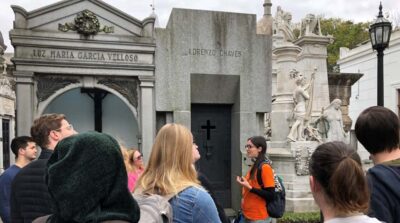
Recoleta Cemetery comes next, with roughly 15 minutes. You can go inside for about 10 minutes and take photographs.
The cemetery is one of the route’s strongest stops because it brings national history down to individual names and family vaults. The guide points out heroes from Argentina and the wider continent, linking the cemetery to the country’s political and religious story.
The short time limit means you should keep moving. If you want a slow, detailed look at every corner, you will need to return separately. This stop can also affect the schedule on busy weekends. One family reported that crossing a crafts market and reaching the cemetery added significant time, so do not schedule an important appointment immediately after the tour.
The cemetery is not just a photo stop. Listen for the way the guide connects religion, politics, fame, and national memory. That is where the visit gains its meaning.
Basilica del Pilar and the faith of Buenos Aires
The Basilica de Nuestra Señora del Pilar receives about 10 minutes. The guide uses the church to explain the importance of religion in Argentina, including the country’s link to Pope Francis, who came from what many Argentinians call the End of the World.
This stop is short, but it rounds out the cultural picture. The tour has already discussed football, university life, migration, and politics. The basilica shows another force that has shaped Argentine identity.
You should expect an exterior explanation and a brief look, not an extended religious tour. If faith and church architecture interest you, treat this as a useful introduction and return later if you want more time.
MALBA and the final museum note
The final listed stop is MALBA, the Museum of Latin American Art of Buenos Aires, with about 15 minutes. Admission is not included.
The museum gives the tour an artistic finish and reminds you that Buenos Aires is more than grand civic buildings and political symbols. Latin American art offers another way to consider identity, modern life, and the region’s shared concerns.
Fifteen minutes is enough for an orientation, but not enough to see the collection properly. If you want to visit MALBA, plan a separate museum outing and budget for your own admission. The short stop is best viewed as a signpost for a later visit, not a substitute for one.
What $39 buys you
At $39 per person, this is a reasonably priced way to combine transport, guiding, equipment, and cultural tastings. You receive the scooter or Segway use, helmet, reflective belt, mate or another listed hot drink, and a dulce de leche alfajor.
The real value is the route. A private taxi or a series of short rides could move you between many of these places, but it would not give you a single guide connecting French influence, football, politics, university life, religion, and Argentine manners.
The price is less compelling if you want long visits inside each attraction. Most stops last 10 to 20 minutes, and MALBA admission costs extra. I would book this for orientation and local interpretation, then return on foot to the places that deserve more time.
The maximum group size of eight also helps justify the cost. You are paying for a guided small-group experience rather than simply hiring a vehicle.
Timing, cancellations, and practical limits
The advertised duration is approximately two hours and 30 minutes. Build in extra time, especially on a weekend. The route can slow near markets and the cemetery, and one reported outing lasted four and a half hours.
Free cancellation is available up to 24 hours before the 2 pm start time. Changes or cancellations within 24 hours are not accepted for a refund. The local cut-off time applies.
The tour may be canceled for poor weather or because the minimum number of participants is not met. In either case, you are offered another date or experience, or a full refund. This minimum-participant rule matters because one booking was changed only a few hours before departure when the minimum was not reached. If your schedule is fixed, ask Rollin Argentina how the minimum is handled before you rely on this as your only afternoon plan.
Who should book the northern Buenos Aires ride
I would choose this tour if you want to see many major sights in one outing and prefer a guide who talks about how the city works, not just what a monument is called.
It suits families, active couples, and first-time visitors who can ride a bicycle and enjoy a little wind. The small group should also suit people who like to ask questions. Children can participate according to the supplied information, and one family found it a good fit for parents and children.
I would hesitate if you dislike two-wheel travel, need a precise end time, or want long museum and cemetery visits. The tour is not recommended if you do not know how to ride a bicycle, and weather can affect the schedule.
Should you book it?
Book it if you want a lively introduction to northern Buenos Aires, with a broad route, strong cultural commentary, and a mate lesson that you can carry into the rest of your trip. Miguel and Rita are the named guides, and the experience clearly depends on the guide’s personality, humor, and willingness to discuss subjects such as politics and the economy.
Skip it if your priority is slow sightseeing or a guaranteed finish after exactly two and a half hours. For most visitors with flexible plans, $39 is a fair price for seeing a lot of the city while learning how football, migration, religion, education, and everyday customs fit together.
FAQ
Where does the tour start?
It starts at Tres Sargentos 463, C1054ABC, in Buenos Aires.
What time does the tour begin?
The scheduled start time is 2 pm.
Where does the tour finish?
The tour ends back at the meeting point.
How long does the experience last?
The approximate advertised duration is two hours and 30 minutes.
How far do you ride?
The route covers about 10 kilometers.
How many people can join?
The maximum group size is eight travelers.
Is a helmet provided?
Yes. A helmet and reflective belt are included.
Is food or drink included?
Yes. You receive a chocolate alfajor filled with dulce de leche and an infusion based on yerba mate. Coffee or tea is also listed.
Can I join if I cannot ride a bicycle?
No. The activity is not recommended for people who do not know how to ride a bicycle.
What happens if the weather is poor?
The experience requires good weather. If the operator cancels because of poor weather, you are offered another date or a full refund.
How far in advance can I cancel for a full refund?
You can cancel at least 24 hours before the experience start time for a full refund. Changes or cancellations made less than 24 hours before the start are not accepted.
Is admission to MALBA included?
No. Admission to the Museum of Latin American Art of Buenos Aires is not included.
Just added around Buenos Aires
- Wine Tasting in Buenos Aires★ 4.2 · 4 reviews
- Tango Show at El Querandi with optional Dinner★ 4.2 · 3 reviews
- Walking Tour: Buenos Aires bookstores★ 4.3 · 12 reviews
- Velez Sarsfield Football Match★ 5.0 · 3 reviews
- Unique Tigre and Delta Private Day Cruise Navegation★ 5.0 · 3 reviews
- Tour Buenos Aires in one day on Electric Scooters★ 5.0 · 33 reviews
- Private Underground Tango Immersion★ 5.0 · 31 reviews
- Experience The Essence of Buenos Aires in San Telmo★ 5.0 · 51 reviews
Buenos Aires Tours, compared.