
Reviewed · WALKING TOURS
Best of Buenos Aires Private Walking Tour
Buenos Aires reveals itself through its buildings, and this private walk gives you a close look at the city’s grandest architecture. In a few hours, you move from Florida Street and Plaza San Martín to French-style mansions, British monuments, old churches, and Recoleta Cemetery, where Argentina’s political and social story is carved in stone.
I like the way the tour connects architecture with power, immigration, money, and politics. I also like the personal feel of a private guide, with past guides such as Martin, Carlos, Mariano, and others praised for clear English, humor, and unusual local stories. The main caution is simple: this is solid walking, and the full route can feel brisk if you stop often for photos.
In This Review
- Key points
- A city tour built around Buenos Aires architecture
- Florida Street to Plaza San Martín
- British monuments and Argentina’s complicated relationship with England
- Palaces, newspapers, and the wealth of Barrio Norte
- A difficult history at the Israeli Embassy site
- Patio Bullrich and the old world of Argentine money
- Avenida Alvear and the road into Recoleta
- An hour inside Recoleta Cemetery
- What the private format adds
- Who will enjoy this Buenos Aires walk
- Ending at La Biela in Recoleta
- Should you book the Best of Buenos Aires Private Walking Tour?
- FAQ
- Where does the tour begin?
- What time should I arrive?
- Where does the tour end?
- How long does the tour last?
- Is the tour private?
- Is an English-speaking guide included?
- Is Recoleta Cemetery admission included?
- Are meals included?
- Are children allowed on the tour?
- What happens if it rains?
Key points
- 25 or more central sights: The route packs in Florida Street, palaces, churches, monuments, embassies, and Recoleta.
- A strong architectural focus: Kavanagh, Palacio Paz, Palacio Estrugamou, and Avenida Alvear show why Buenos Aires is called the Paris of the South.
- History with sharper edges: You hear about British influence, the Falklands War, immigration, wealth, the Israeli Embassy bombing, and Argentina’s political past.
- Recoleta Cemetery included: Allow an hour for Evita Perón, famous families, curious tomb stories, and the cemetery’s grand monuments.
- Private English-language guiding: Your own group takes part, and children aged 8 and under are free with an adult.
- Useful first-day orientation: The walk ends at La Biela in Recoleta, a good place to continue exploring or stop for a meal.
A city tour built around Buenos Aires architecture
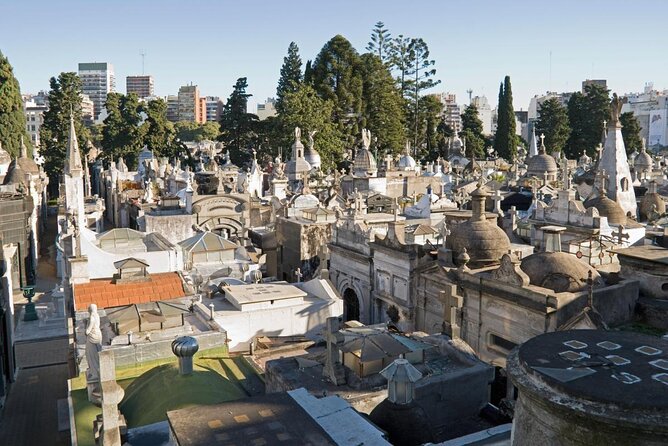
This is not a quick march past a few postcard sights. The route uses buildings as clues to explain how Buenos Aires grew wealthy, why European styles took hold, and how Argentina’s elite once lived.
You begin downtown near Florida Street and finish in Recoleta. Along the way, the city changes in tone. Shopping streets give way to leafy squares, formal palaces, diplomatic buildings, luxury boutiques, and the solemn lanes of Recoleta Cemetery.
The guide is expected to speak English and explain more than dates and names. The strongest part of the experience is the connection between places. The British Clock Tower is not just a landmark. Palacio San Martín is not simply a pretty mansion. Recoleta is not only an affluent district. Each stop helps explain Argentina’s social divisions, foreign ties, religious life, and changing fortunes.
The exact timing is advertised as roughly three hours, while the walking portion is also described as about two and a half hours. In practice, you should plan your morning around a substantial walk, with many short stops and about an hour in the cemetery.
A few more Buenos Aires trips to weigh up
- Buenos Aires Hop-On Hop-Off Bus, Free Walking Tours & Discounts
★ 4.5 · 2,218 reviews - Buenos Aires: La Boca Guided Walking Tour in English
★ 4.8 · 1,587 reviews - Nazis in Buenos Aires: a historical walking tour
★ 4.9 · 193 reviews
Florida Street to Plaza San Martín
Meet outside the corner door of Florida Garden at Florida 899, near Paraguay Street. The group meets no later than 10am, so arrive early. Look for the guide holding or wearing a small BA Walking Tours sign.
The first stretch follows Calle Florida, one of Buenos Aires’ oldest and best-known shopping streets. It links the city’s foundational area around Plaza de Mayo with Plaza San Martín. The guide uses Florida as a quick introduction to the city’s early development, commercial life, and layers of history.
You then reach the Basilica del Santísimo Sacramento. Mercedes Anchorena had the church built for her family in 1916, and its story leads into the world of Buenos Aires’ wealthy families, including their rivalries, relationships, and influence. This is one reason the walk feels different from a basic sightseeing route: the guide uses architecture to discuss the people behind it.
Nearby, the Edificio Kavanagh is an essential stop. This tall Art Deco building overlooks Plaza San Martín and was completed in only 14 months after Corina Kavanagh commissioned it in 1934. She was an Irish-Argentine millionaire who sold two ranches at age 39 to finance the building.
You do not enter the apartments, but the exterior tells plenty. Kavanagh was once the highest skyscraper in Latin America, and its scale still makes sense only when you remember the confidence and wealth of Buenos Aires in the early twentieth century.
British monuments and Argentina’s complicated relationship with England
Plaza San Martín is more than a pleasant green space. It once held a fort, a bullring, and old slave depots before becoming a park named for General José de San Martín, Argentina’s leading independence hero.
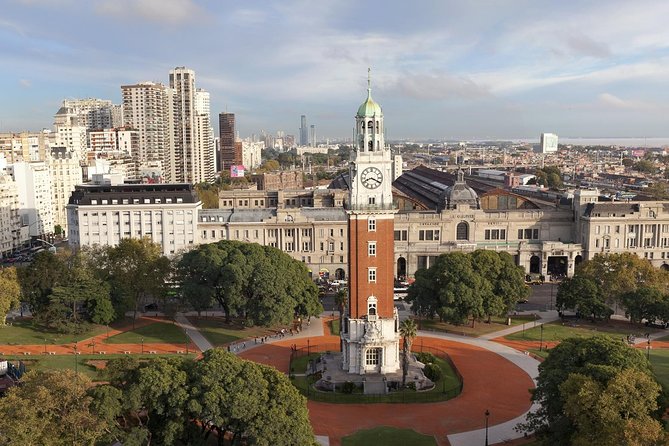
The guide explains San Martín’s role at his monument, then turns to the Torre Monumental. Once known as the British Clock Tower, it reflects the strong British presence in Argentina’s economy and public life. The discussion continues across the street at the monument to those who died in the 1982 Malvinas, or Falklands, War.
This is one of the tour’s most useful historical sections because it avoids presenting Buenos Aires as simply European in appearance. British investment helped shape railways, commerce, agriculture, and finance, while the Falklands dispute remains a sensitive part of Argentine national identity.
The subject can be politically charged, but it gives the grand avenues a more honest context. You see how foreign influence helped build the country, while also learning why that influence has never been viewed in a simple way.
Palaces, newspapers, and the wealth of Barrio Norte
From Plaza San Martín, the route passes several palaces that show how Argentina’s elite wanted to live. Palacio Paz was built in 1914 for José C. Paz, newspaper owner and aspiring president. It was made with materials imported from France and contained 120 rooms for a family of four.
That number tells you something about the social world of the time. These were not modest townhouses. They were city palaces designed to display money, taste, and connections.
Palacio San Martín, originally the Anchorena family palace, continues the theme. Its name changed for political reasons, and the guide explains Mercedes Anchorena’s role in building both the palace and the nearby Basilica del Santísimo Sacramento.
Palacio Estrugamou and the surrounding Barrio Norte streets bring the Paris of the South nickname into focus. Expect Parisian façades, elegant corners, and grand apartment buildings rather than a single famous monument. Along the way, the guide also discusses immigration from Spain, Italy, France, and Britain, and how those arrivals shaped Argentine society.
The route makes clear that Buenos Aires’ European appearance did not happen by accident. It grew from migration, trade, ambition, and a wealthy class eager to position Argentina alongside Europe.
Same city, a completely different kind of day:
- Buenos Aires: Piazzolla Tango Show with Optional Dinner
★ 4.4 · 2,122 reviews - Buenos Aires: City Highlights Guided Tour with Transfer
★ 4.7 · 1,946 reviews - Buenos Aires: Hop-On Hop-Off City Bus Tour
★ 4.2 · 1,855 reviews - Buenos Aires Hop-On Hop-Off Bus and Exclusive Benefits
★ 4.4 · 1,714 reviews
A difficult history at the Israeli Embassy site
The stop at the former Israeli Embassy site adds a serious note to the morning. A 1992 bombing killed 24 people and destroyed the local embassy.
The guide explains what happened, why the attack took place, and the political and legal issues surrounding it. This is not a light sightseeing anecdote, and some people may find the subject heavy amid the palaces and shopping streets. Still, it gives you a fuller sense of Argentina’s modern history and reminds you that the city’s elegant façades exist alongside painful political events.
The nearby French Embassy, once the Ortiz-Basualdo Palace, returns the walk to architecture and royal gossip. One story concerns Edward VII of England and his visit with his future American wife. The details help bring the building’s social world to life without requiring a formal museum visit.
Patio Bullrich and the old world of Argentine money
Patio Bullrich offers one of the route’s most surprising changes. Today it is an upscale shopping center, but the building began as a British-designed horse and cattle auction house in 1867.
The Bullrich family used it to sell prized bulls, thoroughbreds, heirlooms, and collectibles. That earlier role points to Argentina’s agricultural wealth and the British influence behind parts of the country’s commercial system.
Inside a modern mall, it can be hard to imagine livestock auctions and elite salesrooms. That contrast is exactly why the stop works. Buenos Aires often repurposes old structures rather than wiping away their earlier lives, and a guide can point out what you would probably miss while shopping.
The walk then passes the Apostolic Nunciature, a former palace donated to the Vatican by Adelia Harilaos. Here you hear about Argentina’s connection to the Catholic Church, the role of wealthy women such as the Anchorena, Harilaos, and Alvear families, and why Argentina produced a pope.
Avenida Alvear and the road into Recoleta
Avenida Alvear is one of the most elegant streets in Buenos Aires. Its grand mansions and formal façades show how the city’s upper class imagined high society between roughly 1880 and 1930.
The guide uses the avenue to explain immigration and Argentina’s rise and decline. You get a visual lesson in the country’s former wealth, but also a reminder that prosperity was uneven and depended heavily on agriculture, exports, and the power of a small elite.
Recoleta continues the same architectural mood with French-style townhouses, former palaces, high-end shops, and broad streets suited to a slow stroll. The district began with land given to Franciscan Recoletos monks, but its present character grew from later wealth and urban development.
The route includes the Basilica de Nuestra Señora del Pilar, completed in 1732 as part of the Franciscan Recoletos monastery. It is the second-oldest church in Buenos Aires. The church visit gives the tour a welcome change from grand secular buildings and political monuments.
An hour inside Recoleta Cemetery
The cemetery is the tour’s main extended stop, with about an hour set aside for a detailed visit. This is not a quick walk to Evita Perón’s tomb followed by an exit.
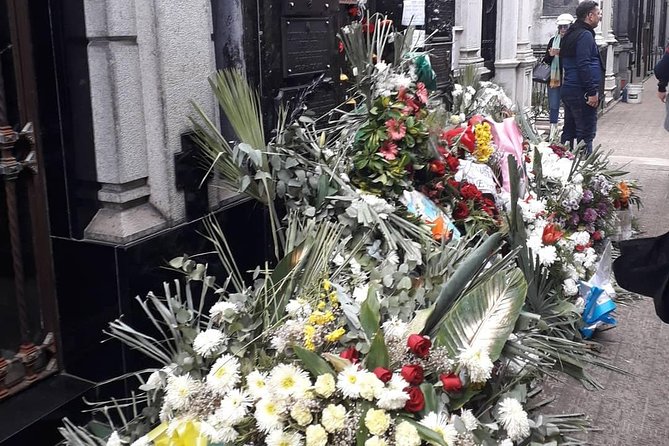
You learn about Evita’s life and memorial, then move among the mausoleums of military leaders, writers, wealthy families, and public figures. Stories include Rufina Cambaceres’ misfortune, Tiburcia Domínguez and her miserly husband, Admiral Brown, the wealthy Leloir family, General Guido, and Liliana Crociatti.
Some tales are curious, some sad, and some reveal the values of the families who built these small stone houses for the dead. The cemetery is most interesting when you look beyond its famous names. Ornate mausoleums, narrow lanes, religious statues, and family memorials show how Buenos Aires’ elite wanted to preserve status after death.
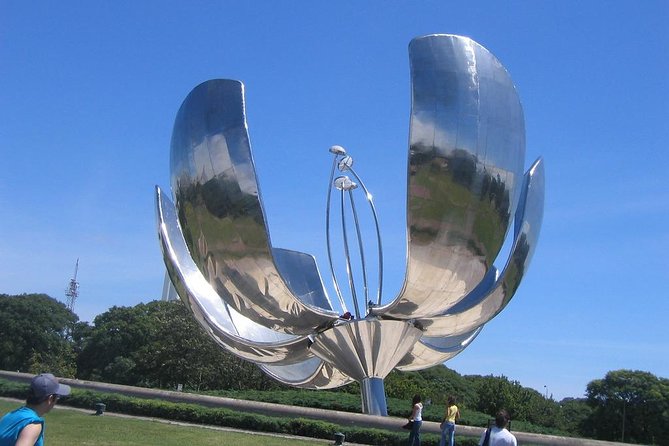
The visit also places the cemetery within a wider cultural setting. The guide points out the Pilar Basilica, the former monastery and cultural center, Bourdelle’s monument to Alvear, and the Palais de Glace, associated with tango’s development. Depending on timing and conditions, the route may also include the National Fine Arts Museum, the giant flower sculpture, the National Library, Palermo Chico, and other nearby landmarks.
The full cemetery and surrounding-area plan can change with weather, city repairs, strikes, protests, or the pace of the group. If a particular sight matters most to you, ask the guide early in the walk.
What the private format adds
At $109 per person, this is not the cheapest way to see Buenos Aires. The value depends on how much you want from a guide and how many people are in your group.
You are paying for a private English-language experience rather than a large group walk. That can make a real difference in a city where architectural details and political history need explanation. You can ask questions, adjust the pace within reason, and focus on subjects that interest you, such as immigration, churches, Argentina’s elite, or the Falklands conflict.
Past guides including Martin, Carlos, and Mariano have been singled out for humor, clear English, strong local knowledge, and lively storytelling. One guide was especially praised for explaining social, economic, and political history, while another made the walk enjoyable even in the rain.
There are limits. The route covers a lot of ground, and the large number of stops means some buildings receive only a few minutes. If you prefer a slow photography walk or long interior visits, this may feel too packed. One reported experience also ended with the group finding its own way back from Recoleta, so remember that hotel pickup and return are not included.
Who will enjoy this Buenos Aires walk
I would choose this tour for a first morning in Buenos Aires, especially if you want a clear sense of how the central districts connect. It is also useful after a bus tour, since the walking format gets you close to façades, monuments, churches, and street details.
You should be comfortable walking continuously for about two and a half hours or more. Wear practical shoes, bring water, and prepare for changing weather because the tour runs rain or shine.
The private setup suits couples, families, and small groups who want their own guide. Children aged 8 and under are free when accompanied by an adult, though the long walking distance may still be tiring for very young children.
The tour is less suitable if you want extensive time inside museums, a food-focused outing, or a route centered on tango performances. It is primarily a city history and architecture walk, with the cemetery as its main interior-style visit.
Ending at La Biela in Recoleta
The walk ends outside La Biela, the famous café at Avenida Presidente Manuel Quintana 596. The guide explains the café, the Recoleta neighborhood, and nearby sights before leaving you to continue independently.
This is a useful finish. You are not dropped in an unfamiliar district with no idea what to do next. From La Biela, you can remain in Recoleta for restaurants, boutiques, museums, and the cemetery area.
Because there is no hotel drop-off, plan your return before the tour begins. Recoleta is close to public transportation, but your own route depends on where you are staying.
Should you book the Best of Buenos Aires Private Walking Tour?
Book it if you want a compact but serious introduction to Buenos Aires, with a guide who can explain why the city looks the way it does. The strongest features are the private format, the wide mix of neighborhoods, the architectural detail, and the extended Recoleta Cemetery visit.
Skip it if you dislike long walks, need frequent breaks, or prefer to explore just one district at a relaxed pace. At $109 per person, the price makes the most sense for a small private group that values live explanation and local stories.
For a first visit, I would schedule it early in your stay. It gives you a useful map of central Buenos Aires and Recoleta, then leaves you with plenty of places to return to on your own.
FAQ
Where does the tour begin?
It begins outside Florida Garden at Florida 899, near the corner with Paraguay Street, in Buenos Aires.
What time should I arrive?
The meeting takes place no later than 10am. Arrive early and look for a guide holding or wearing a small BA Walking Tours sign.
Where does the tour end?
It ends outside La Biela café at Avenida Presidente Manuel Quintana 596 in Recoleta.
How long does the tour last?
The experience lasts approximately three hours, while the walking portion is also described as about two and a half hours.
Is the tour private?
Yes. Only your group participates in this private tour or activity.
Is an English-speaking guide included?
Yes. A professional English-speaking guide is included.
Is Recoleta Cemetery admission included?
Yes. The cemetery admission ticket is included, along with a detailed visit.
Are meals included?
No. Meals are not included.
Are children allowed on the tour?
Yes. Children aged 8 and under are free when accompanied by an adult.
What happens if it rains?
The tour operates rain or shine. The full itinerary can change because of weather, city repairs, strikes, protests, or other conditions at the time of the tour.
Just added around Buenos Aires
- Tango Show at El Querandi with optional Dinner★ 4.2 · 3 reviews
- Wine Tasting in Buenos Aires★ 4.2 · 4 reviews
- Walking Tour: Buenos Aires bookstores★ 4.3 · 12 reviews
- Velez Sarsfield Football Match★ 5.0 · 3 reviews
- Unique Tigre and Delta Private Day Cruise Navegation★ 5.0 · 3 reviews
- Private Underground Tango Immersion★ 5.0 · 31 reviews
- Tour Buenos Aires in one day on Electric Scooters★ 5.0 · 33 reviews
- Transfers from or to the airport In Argentina Your Best Choice★ 5.0 · 28 reviews
Walking Tours, compared.
Nazis in Buenos Aires: a historical walking tour
Read our review →
La Docta Free Walking Tour “Córdoba La Antigua”.
Read our review →
Buenos Aires Walking Tour with Local Guide and Optional Rooftop
Read our review →
Browse the lists this tour appears in